The slides investors question hardest are the ones built on outside facts: the market size, the growth rate, the competitor map and the "why now". Those are the slides Rixx researches. It searches the live web, reads the reports and filings it finds, computes the sizing, and puts the source on the slide.
Your own story, metrics and team stay yours. Rixx builds the deck around them, or leaves clear placeholders where your numbers go.
Sample deck: Lumen Health (fictional)
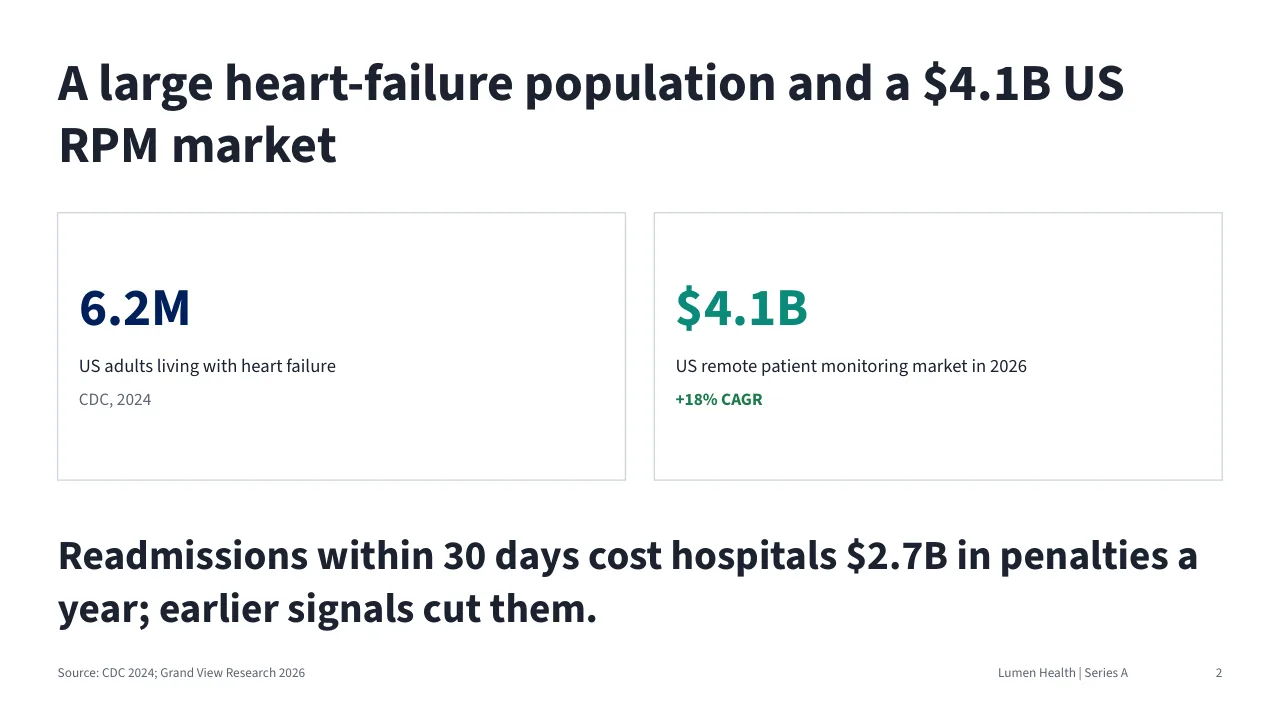
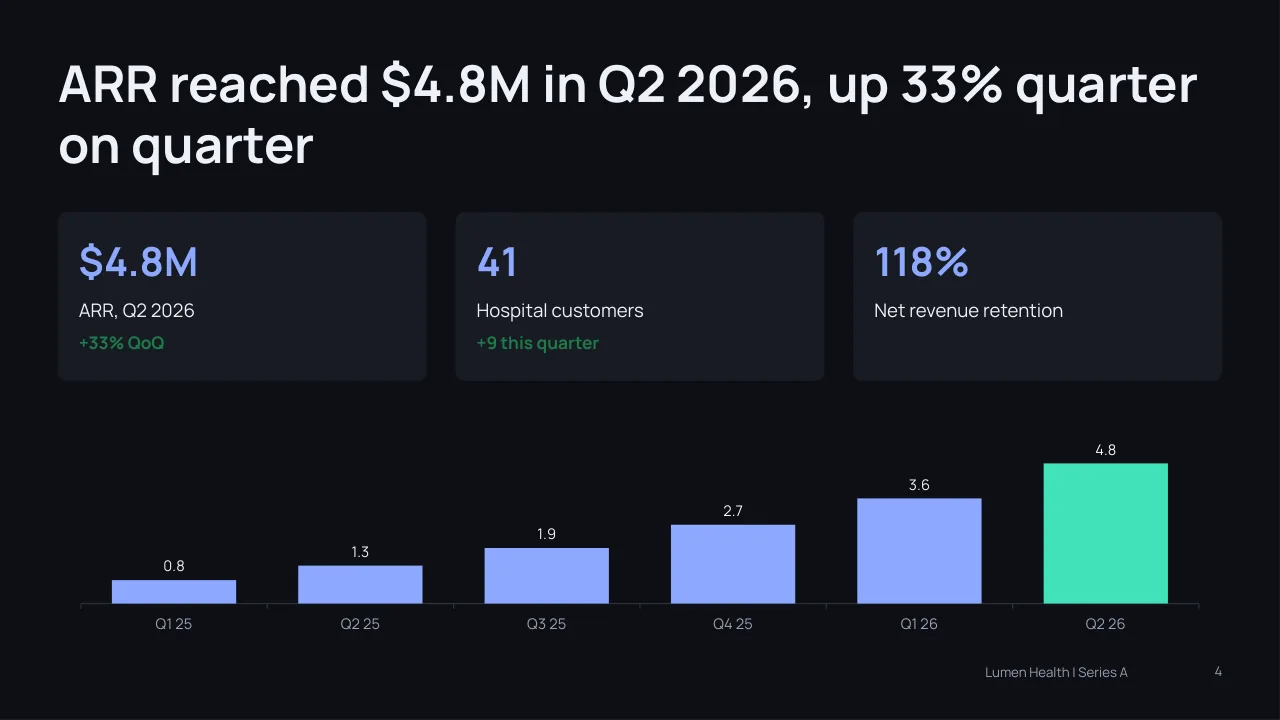
The slides on this page come from a sample Series A pitch deck Rixx built for Lumen Health, a fictional remote heart-failure monitoring company. The company, its traction and its metrics are made up for the sample. The market slide shows how Rixx handles outside facts: each statistic has a named source in the footer.
The same deck exists in all six themes: Editorial, Swiss, Corporate, Bold, Dark and Consulting. See them on the examples page.
The standard investor deck order
Most seed and Series A decks follow a familiar order of 10 to 13 slides. Rixx uses it by default, and you can change it in your request.
| # | Slide | What Rixx researches or builds |
|---|---|---|
| 1 | Cover | Company name, one-line description, round |
| 2 | Problem | Cited figures on how big and costly the problem is |
| 3 | Solution | Your product, in plain words, from your notes |
| 4 | Why now | Recent regulation, technology or cost shifts, each cited |
| 5 | Market size | TAM, SAM and SOM with sources and stated assumptions |
| 6 | Product | A product walkthrough from your notes |
| 7 | Business model | Pricing and unit economics from your inputs |
| 8 | Traction | Native charts of your metrics |
| 9 | Competition | A researched comparison table or a 2x2 |
| 10 | Go-to-market | Channels and first customers |
| 11 | Team | From your notes |
| 12 | Financials | Summary charts, optionally from an Excel model |
| 13 | The ask | Amount, use of funds and milestones |
Market sizing with sources
Market size is where most decks lose credibility. A single large number from an unnamed report invites the question "where is that from?", and an investor who checks will notice if it doesn't hold up.
Rixx sizes a market the way an analyst would:
- Top-down. It finds published market estimates, names the publisher and year, and notes when sources disagree.
- Bottom-up. It counts the customers you can actually reach and multiplies by a realistic price. For example: number of US hospitals with a cardiology department, times the share that run remote monitoring, times your annual contract value.
- Stated assumptions. Every input sits on the slide or in the notes with its source, so you can swap one out and rerun.
- A workbook if you want it. Ask for the sizing in Excel and Rixx returns a model with working formulas and a sources tab. The AI spreadsheet generator covers models in more depth.
A typical prompt: "Size the US market for remote heart-failure monitoring. Give TAM, SAM and SOM, top-down and bottom-up, with a source for every input."
The competitor slide
Rixx researches competitors the same way. Name your space, or list the companies you already know, and it reads their sites, pricing pages and public announcements. You get a comparison table on the slide, with a link for each fact in the chat, and a 2x2 positioning slide if you ask for one.
For bigger landscapes, Rixx can split the research across parallel agents, one group of companies each, and merge the results into one table. For a full competitor report rather than a slide, use AI competitor analysis.
Building from your own material
Founders rarely start from a blank page. Attach what you have and Rixx builds the deck from it:
- A one-pager, memo or old deck. Rixx keeps your story and restructures it into the investor order.
- A metrics export or CSV. Rixx uses its own private workspace, with a full terminal and Python, to compute growth, retention and cohort figures, then charts them as native PowerPoint charts.
- A financial model. Rixx summarises it on a financials slide and keeps the figures consistent with the workbook.
Your figures are cited as your files, and the web research is cited to the web, so a reader can always tell which is which.
Tips for a stronger deck
- Say the round and the audience. "Seed deck for healthcare-focused angels" changes what Rixx emphasises.
- Give your real numbers. Attach them, or ask Rixx to leave placeholders. Don't let estimates stand in for your own traction.
- Ask for the bottom-up sizing. Investors trust a count of real customers more than a headline market figure.
- Keep the appendix. Ask Rixx to move detailed sources and extra charts to appendix slides so the main deck stays short.
- Iterate in chat. "Cut to 10 slides", "make the market slide more conservative" or "switch to the Dark theme" returns an updated file.
Related jobs
- Researching the market first? Use the AI market research generator.
- Need a deck that isn't a pitch? See the AI presentation maker.
- Need charts on their own? Use the AI chart generator.
- See how founders use Rixx beyond the deck on the founders page.
Frequently asked questions
Where do my traction numbers come from?
From you. Rixx uses the metrics you attach and cites them as your files. If you haven't shared them yet, ask for clearly marked placeholders and Rixx fills the slides it can research.
How does Rixx calculate TAM, SAM and SOM?
It combines published market estimates (top-down) with a count of reachable customers times price (bottom-up). Every input has a source, and the assumptions are listed so you can change them.
Where do the sources appear in the deck?
Slides that use outside facts carry the source on the slide, and the deck ends with a sources list. In the chat, each fact links to the page Rixx read.
Can I edit the deck in PowerPoint or Google Slides?
Yes. You get a standard .pptx file with native charts and tables. Every element is editable in PowerPoint, Google Slides and Keynote.
Can Rixx also build the financial model?
Yes. Ask for an Excel workbook alongside the deck. It returns working formulas, recalculated and checked, with the inputs and sources on their own tab.
Is Lumen Health a real company?
Lumen Health is a fictional company made up for the sample. Its metrics are illustrative. The market slide shows how Rixx cites outside statistics.
Is it free to try?
Yes. Every plan, including Free, gets every feature, and Free includes 50 credits a day plus 500 a month. A researched pitch deck uses more credits than a quick answer, and you only pay for what a job uses. See pricing.