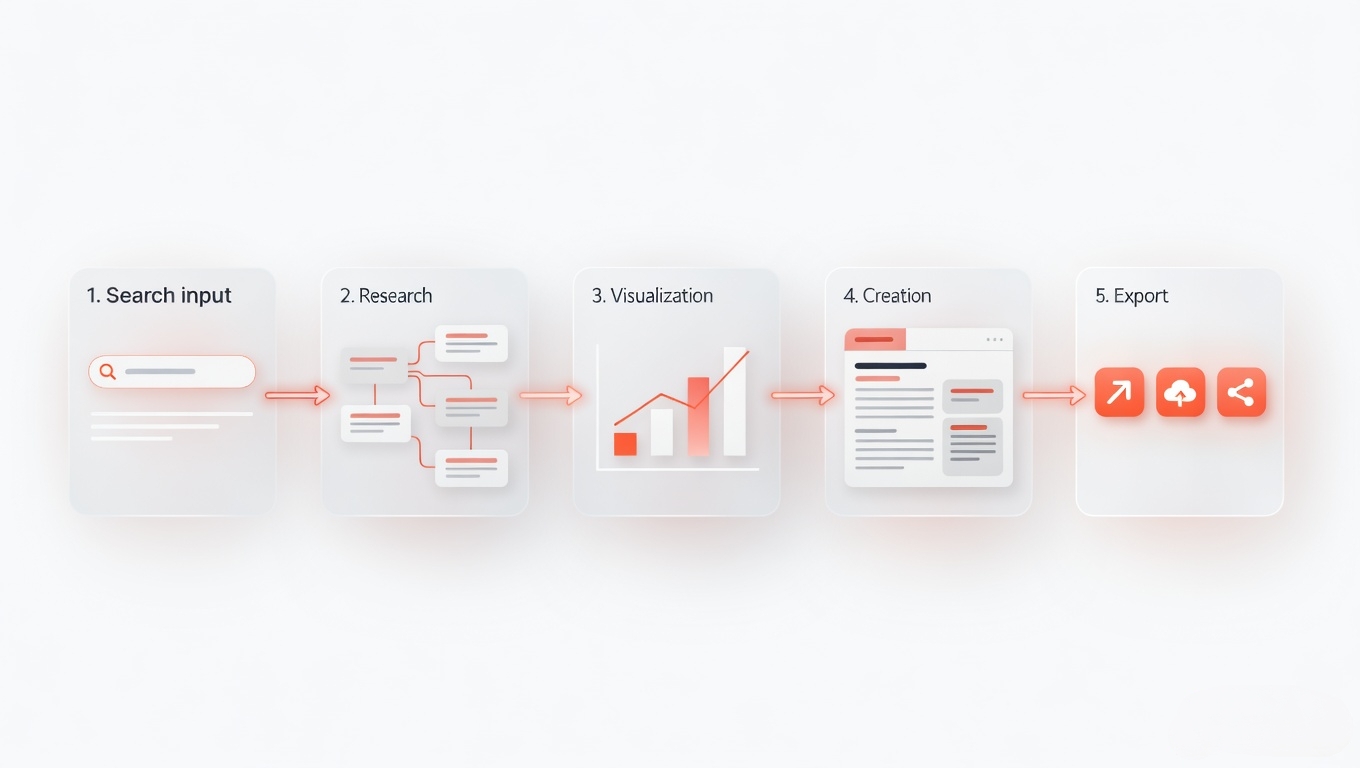
Rixx helps you research a market, compare competitors, analyze supporting documents, create charts, and export a source-backed brief from one workspace.
Use it for the first structured pass on a market question—not as a substitute for primary research, proprietary databases, or analyst judgment.
What is an AI market research generator?
An AI market research generator turns a business question and available evidence into a structured research output.
A useful tool should do more than produce a confident paragraph. It should help you:
- define the market and decision;
- gather current sources;
- inspect citations;
- add reports and spreadsheets;
- compare companies or segments;
- identify missing and conflicting evidence;
- create charts or tables;
- export a reviewable report.
Rixx keeps those steps in one research thread so the result can be checked and reused.
What you can create
Market overview
Create an initial view of market structure, customer segments, major participants, business models, demand signals, and open questions.
Competitor matrix
Compare competitors across criteria such as pricing, target customer, positioning, distribution, product capabilities, geography, and public strategic signals.
Use the dedicated AI competitor analysis tool for a more focused workflow.
Pricing comparison
Collect current public pricing evidence, normalize plan differences, state currencies and billing periods, and mark unavailable information clearly.
Market-entry brief
Organize public evidence around customers, competitors, channels, regulation, localization, barriers, and assumptions for a target geography.
Trend and signal report
Gather dated evidence about product launches, investment, regulation, hiring, partnerships, or changing customer behavior. Separate observed signals from forecasts.
Charts and visual explanations
Turn reviewed values into charts, graphs, tables, or Mermaid diagrams. When the evidence begins in a document, use AI chart from PDF.
Exportable research report
Combine the findings, source trail, visualizations, limitations, and next questions into PDF, Word, or Markdown.
How to generate a better market-research report
Step 1: Frame the question precisely
Include:
- the decision the research will support;
- market definition;
- geography;
- timeframe;
- target customer;
- comparison criteria;
- expected output.
Example:
Create an initial competitor and pricing map for AI customer-support software sold to US SaaS companies with 50–500 employees. Compare five relevant products using current official sources. Include positioning, public pricing, integrations, target customer, evidence gaps, and a cited comparison table.
Step 2: Review the search plan and sources
Inspect the searches and sources used. Prefer first-party evidence for product, pricing, and company claims. Add independent sources when they contribute context or challenge a company’s own framing.
Step 3: Upload relevant evidence
Add reports, PDFs, spreadsheets, notes, or screenshots that should inform the analysis. Clarify which sources are authoritative for the task.
Step 4: Normalize the evidence
Market sources often disagree because they measure different things.
Ask:
- Do the figures use the same market definition?
- Are currencies and periods consistent?
- Is a number historical, current, or forecast?
- Is the source primary or quoting another report?
- Are plan prices monthly, annual, per-seat, or usage-based?
Step 5: Surface uncertainty
Ask Rixx to list:
- missing values;
- single-source claims;
- conflicting figures;
- inaccessible evidence;
- assumptions;
- statements that require expert validation.
Step 6: Create the output
Choose the right artifact for the audience:
- one-page executive brief;
- competitor matrix;
- pricing table;
- market map;
- chart;
- detailed report;
- Markdown research pack.
Step 7: Verify before use
Open citations, confirm the wording and date, check numerical transformations, and review the final document as an analyst—not just as an editor.
Prompt templates
Market landscape
Map the [market] in [geography] for [customer type]. Identify the main segments, representative companies, business models, demand signals, and important unknowns. Use dated sources, prefer primary evidence, and separate facts from interpretation.
Competitive intelligence
Compare [competitors] across [criteria]. Cite each material claim, use official product and pricing pages where possible, state the review date, and use “not publicly available” instead of estimating missing values.
Market sizing evidence review
Find current estimates for [market]. For each estimate, capture the publisher, publication date, base year, forecast period, geography, market definition, currency, reported value, and whether the methodology is public. Do not average incompatible estimates.
Client-ready brief
Turn the reviewed research into a concise client brief with executive summary, evidence table, competitor matrix, key implications, risks, unknowns, and next research questions. Keep citations attached and avoid unsupported recommendations.
Why source visibility matters
Market research often contains precise-looking numbers built on unclear definitions. A citation is useful only when it supports the exact claim being made.
Rixx keeps queries, source references, files, follow-ups, and outputs close to the answer. This makes review easier, but it does not guarantee that every source is authoritative or every interpretation is correct.
For a deeper verification method, read the Rixx guide to checking cited AI answers on the Rixx Blog.
Who this tool is for
Independent consultants
Create a defensible first draft for a market scan, competitor review, proposal, or client workshop.
Market and competitive-intelligence analysts
Bring public sources, reports, spreadsheets, charts, and recurring research questions into one workflow.
Product marketers
Research category language, competitor claims, public pricing, segments, and positioning evidence for a battlecard or launch brief.
Founders
Structure early market questions and identify assumptions that require interviews, customer evidence, or proprietary data.
Research-heavy content teams
Build a source pack, evidence table, and visual before drafting a report, white paper, or comparison article.
What Rixx does not replace
Rixx does not replace:
- customer interviews;
- surveys or panel research;
- expert calls;
- paid market databases;
- proprietary transaction data;
- legal or regulatory review;
- financial or investment analysis;
- human validation.
Deep Research is coming soon. Today, Rixx supports user-directed cited web research, mixed-file analysis, contextual follow-ups, visualizations, and exportable outputs.
Frequently asked questions
Is the AI market research generator free?
Rixx is free to start. Paid plans provide higher research capacity and broader AI options. Check current pricing for plan details.
Does Rixx use current web information?
Yes. Rixx can search the current public web and cite the sources used. Some pages may be inaccessible, paywalled, outdated, or incomplete.
Can I add my own market reports?
Yes. Supported PDFs, documents, spreadsheets, images, text files, and links can be included in the research context.
Can it generate a TAM, SAM, and SOM calculation?
Rixx can help organize assumptions and perform calculations, but market sizing depends on reliable definitions and evidence. Review every input, formula, and assumption before using the result.
Can it create competitor reports?
Yes. Rixx can collect and structure cited evidence, compare competitors, create charts or matrices, and generate an exportable report.
Can it create charts?
Yes. Rixx supports interactive charts, Python-backed static charts, graphs, and Mermaid diagrams. Verify the source data before sharing the result.
Can I export the research?
Yes. Rixx supports PDF, Word, and Markdown outputs as well as shareable full conversations.
Start with a real market question
Define the decision, add your evidence, inspect the sources, and turn the reviewed findings into a useful research asset.