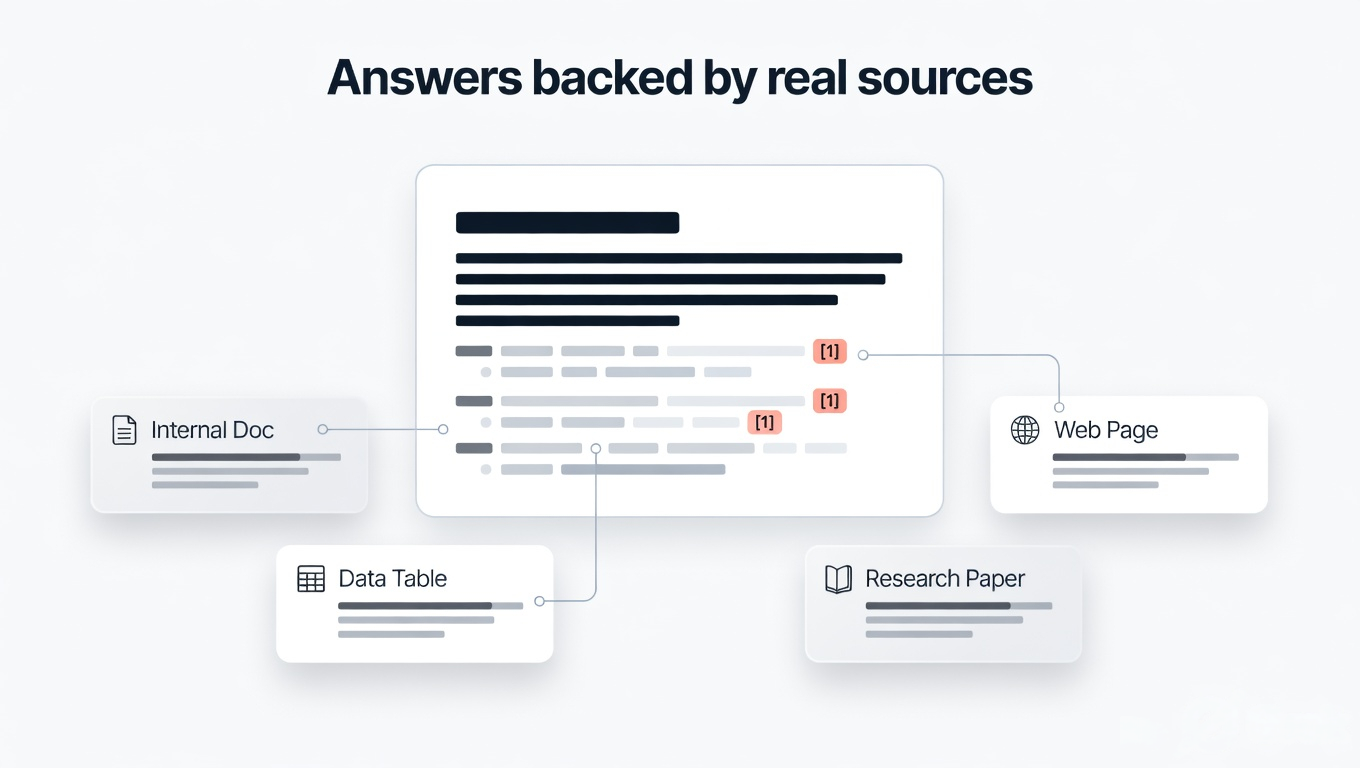
The short answer: Choose Consensus when your question should be answered primarily from peer-reviewed research and you want paper-focused features such as Study Snapshots, academic filters and the Consensus Meter. Choose Rixx when you need to connect scholarly evidence with the current web, internal documents, spreadsheets, images, Python analysis and a finished report or visual.
Consensus and Rixx both make sources visible, but they start from different evidence universes. Consensus describes itself as an academic search engine built on a large corpus of research papers. Rixx searches the live web and can combine those sources with files you provide. That makes Consensus more focused and Rixx more flexible.
The deciding question is simple: Should the answer come mainly from scientific papers, or must it synthesize several kinds of evidence?
Rixx vs Consensus at a glance
| Capability | Rixx | Consensus |
|---|---|---|
| Primary source base | Live web plus uploaded documents, data, images and links | Academic research papers |
| Citation-backed answers | Yes, with visible queries, steps, source panels and snippets | Yes, with answers tied to research papers |
| Academic discovery | Broad web research that can include scholarly sources | Purpose-built semantic and keyword paper search |
| Evidence snapshots | Can create requested evidence tables from source context | Study Snapshot extracts methodology, sample size and outcomes |
| Agreement visualization | Custom charts or tables when suitable data is available | Consensus Meter summarizes agreement for supported yes/no questions |
| Deep literature work | Deep Research coming soon | Deep review available now and designed for literature synthesis |
| Uploaded paper Q&A | Yes | Yes; Chat with Full Text supports papers, collections and uploaded documents |
| Mixed business files | PDF, DOCX, text, spreadsheets, CSV, images and links | Primarily research papers and uploaded documents |
| Data analysis and diagrams | Python analysis, charts, graphs and Mermaid | Research-focused analysis and product-specific visual features |
| Outputs | PDF, DOCX and Markdown generation/export; shareable chats | Literature reports and scholarly export options; availability varies by feature and plan |
| Starting price | Free; Explorer $10/month, Pro $20/month, Max $99/month | Free and paid plans; see Consensus subscriptions |
| Best fit | Cross-source research that becomes analysis or a deliverable | Rapid discovery and synthesis of peer-reviewed evidence |
This table compares documented product scope. It does not claim that either tool has higher accuracy, coverage or retrieval quality in every field.
Choose Consensus for a paper-first answer
Consensus is designed for questions such as “Does this intervention improve an outcome?” or “What does the research say about this relationship?” Its official FAQ describes paper search, cited synthesis, advanced filters, Study Snapshots, the Consensus Meter, full-text chat, a library and reference-manager integrations.
That focus can reduce noise when you specifically want academic evidence rather than the open web. Its Deep review feature is also available now for longer literature analyses. Consensus is likely the better fit when you want:
- a search experience centered on peer-reviewed papers;
- quick extraction of study design, sample and outcomes;
- filters built for academic research;
- a visual signal of agreement for an eligible yes/no research question;
- literature-oriented exports and reference-manager workflows.
A Consensus Meter is a navigational summary, not a substitute for reading the underlying studies. Study quality, heterogeneity, publication bias and differences in population or outcome can still change the interpretation.
Choose Rixx for decisions that need more than papers
Real-world decisions often combine scientific evidence with information that is not in journals: current regulations, product documentation, government data, internal spreadsheets, stakeholder notes and recent events. Rixx lets you bring those inputs into the same conversation.
Rixx is a stronger fit when you want to:
- inspect the searches, steps, citations and source snippets behind a web answer;
- compare an academic paper with a policy PDF or live guidance;
- analyze a spreadsheet or CSV with Python;
- turn evidence into charts, graphs or a Mermaid process diagram;
- create a PDF, DOCX or Markdown brief for a specific audience;
- retain reusable instructions in private Skills and use memory across work.
Explore Rixx for researchers or see how the AI report generator connects evidence to an output.
A practical Rixx workflow
Consider a workplace-wellbeing team evaluating a proposed program:
- Ask Rixx to find recent peer-reviewed evidence and current guidance from reputable health or labor organizations.
- Inspect the cited snippets and label each source by type rather than treating all evidence as equivalent.
- Upload the vendor proposal, an internal survey CSV and a PDF of the existing policy.
- Ask Rixx to build an evidence table separating research findings, organizational guidance, vendor claims and internal observations.
- Use Python to summarize survey results and generate a chart. Add a Mermaid diagram showing the proposed rollout and evaluation checkpoints.
- Export a decision memo as DOCX or PDF with assumptions, risks, open questions and linked evidence.
The workflow helps organize evidence; it does not establish causality or replace statistical, clinical or domain review.
Important limitations
- Rixx is not a dedicated academic database and does not currently offer a native equivalent of Consensus Meter or Study Snapshot.
- Rixx Deep Research is coming soon. Consensus Deep review is available now, subject to usage limits.
- Rixx MCP is coming soon, not a current capability.
- Consensus is narrower by design. That can be an advantage for paper-first questions and a limitation when current web or internal business context matters.
- AI summaries can flatten disagreement or miss methodological details. Read important papers and verify quoted numbers against the full text.
- Neither tool should be the sole basis for medical, legal, safety or policy decisions.
Frequently asked questions
What is a good Consensus alternative?
Rixx is a good alternative when you need cited research across the live web and your own files, followed by data analysis, visualization or document export. For a search constrained primarily to academic papers, Consensus remains more specialized.
Is Rixx an academic search engine?
Rixx is a general AI search and research workspace, not a dedicated academic-paper database. It can support literature research and analyze papers, but users conducting formal reviews should also use appropriate scholarly databases and review methods.
What is the difference between Rixx and Consensus?
Consensus starts with a research-paper corpus and paper-specific tools. Rixx starts with live-web search and supports a wider range of private inputs and outputs, including spreadsheets, CSVs, images, Python analysis, diagrams and generated documents.
Does Rixx provide citations?
Yes. Rixx provides cited answers and exposes queries, research steps, source panels and snippets to make verification easier.
Can Rixx create evidence tables and charts?
Yes. Rixx can organize findings into tables and generate charts or graphs when the source data supports them. It can also use Python for suitable analysis tasks. Verify extracted and calculated values before relying on them.
Does Rixx have the Consensus Meter?
No. Rixx can create a custom visualization from suitable evidence or data, but it should not be presented as having Consensus’s branded Meter feature.
Which tool is better for a literature review?
Consensus is a focused option for discovering and synthesizing academic papers. Rixx may be more suitable when the literature review must incorporate live-web context, varied file types, custom analysis and a final deliverable. Formal reviews still require a documented search and appraisal process.
Build the brief around all the evidence
Use Rixx to connect cited web research, papers, internal files and data—then turn the work into a chart, report or shareable research trail.