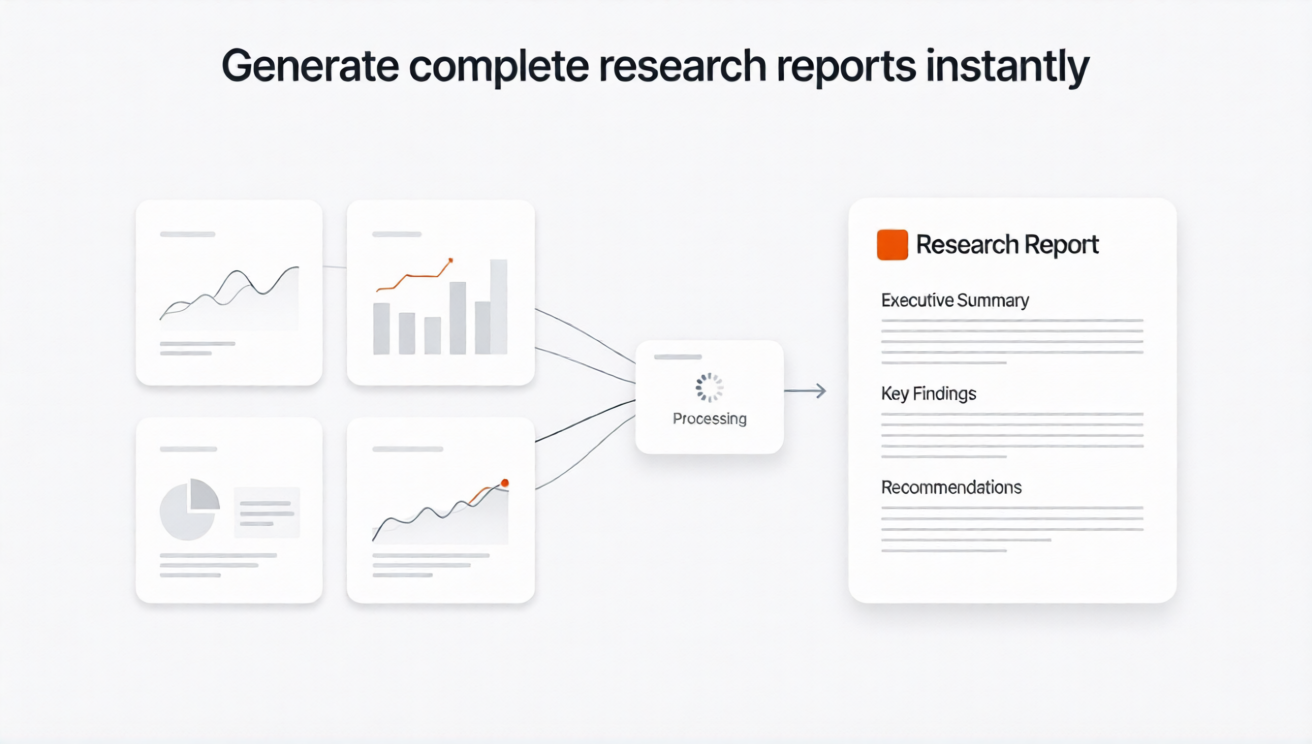
Rixx helps independent consultants and small consulting teams move from a client question to a reviewable research asset.
Search the current web with citations, add approved PDFs and spreadsheets, compare competitors, create charts, and export the findings as PDF, Word, or Markdown without rebuilding the work across separate tools.
Try Rixx for consulting research
Consulting research has to become an artifact
A client does not pay for browser tabs. The research must become a market map, competitor matrix, diligence note, executive memo, chart, recommendation, or report.
The difficult part is preserving the connection between the deliverable and the evidence behind it.
Rixx keeps these activities in one workspace:
- live cited web research;
- visible queries, research steps, sources, and snippets;
- analysis of approved PDFs, documents, spreadsheets, CSVs, images, and links;
- contextual follow-up questions;
- Python-assisted data analysis;
- charts, graphs, and Mermaid diagrams;
- PDF, Word, and Markdown outputs;
- full-conversation sharing;
- memory and reusable private Skills.
Consulting workflows supported by Rixx
Market and category scans
Map segments, competitors, business models, customer groups, pricing signals, and important unknowns.
Competitor analysis
Build a cited comparison of positioning, target market, public pricing, product capabilities, and strategic announcements.
Use the AI competitor analysis tool for a dedicated workflow.
Market-entry research
Organize evidence about customers, incumbents, regulation, channels, localization, and barriers in a target geography.
Commercial diligence support
Gather public evidence, review supplied documents, and create an initial issue list. Rixx does not replace expert calls, proprietary databases, financial diligence, legal review, or primary research.
Client document analysis
Analyze approved reports, presentations, spreadsheets, and other supported files. Follow the client’s confidentiality, retention, and security rules before uploading material.
Source-backed charts and reports
Create a visual or report from reviewed research without losing the supporting thread.
A practical consulting workflow
1. Translate the client request into a research brief
Define:
- decision and audience;
- scope;
- geography;
- timeframe;
- comparison criteria;
- approved evidence;
- expected deliverable;
- confidentiality constraints.
2. Build the evidence base
Search current public sources and inspect the query and source trail. Upload only material approved for the chosen system.
3. Structure the analysis
Create a competitor matrix, issue tree, evidence table, market map, or hypothesis list. Keep observations separate from interpretation.
4. Challenge the result
Ask what is missing, contradictory, stale, inaccessible, or supported by only one source.
5. Create the deliverable
Generate the appropriate chart, table, report, or memo and export it to the required format.
6. Conduct human review
Validate every consequential claim and recommendation. Consultants remain accountable for the work shared with clients.
Example prompts
Competitor matrix
Compare [competitors] for a [client profile] across positioning, target customers, public pricing, capabilities, geographic coverage, and recent strategic signals. Prefer official sources, cite every material claim, and mark missing information instead of estimating it.
Market-entry brief
Build an initial market-entry research brief for [product] in [country]. Cover market structure, customer segments, incumbents, channels, regulation, pricing evidence, risks, unknowns, and the primary-research questions that remain.
Evidence audit
Audit this client brief. Flag unsupported claims, weak or stale sources, inconsistent figures, missing dates, assumptions presented as facts, and recommendations that require additional evidence.
Client-ready report
Turn the reviewed findings into an executive report with a concise summary, methodology, evidence table, competitor matrix, chart, implications, limitations, and next steps. Keep citations attached.
Why consultants may choose Rixx
Research and output stay connected
Move from web evidence and files into tables, visuals, and documents within the same thread.
Sources remain inspectable
Review citations, queries, steps, snippets, and source panels before using a claim.
Mixed files and data
Work with supported documents, spreadsheets, CSVs, images, and links alongside public-web evidence.
Reusable workflows
Memory and private Skills can help preserve recurring instructions for market scans, comparison tables, report structures, or evidence reviews.
Shareable review trail
Share the full research conversation or export the final artifact for review.
Important limitations
- Rixx is not a substitute for consultant judgment or quality assurance.
- It does not provide guaranteed access to proprietary databases or paywalled research.
- Deep Research and MCP are coming soon, not currently available.
- Public information can be outdated or incomplete.
- Uploaded files, extracted data, citations, calculations, and charts require review.
- Do not upload confidential client data without authorization and an appropriate security assessment.
- Rixx does not provide legal, financial, medical, or investment advice.
Frequently asked questions
Can Rixx create consulting reports?
Yes. Rixx supports report workflows using cited research, approved files, tables, charts, and contextual follow-ups, with PDF, Word, and Markdown outputs.
Can consultants upload client documents?
Rixx supports document uploads. Consultants must follow client agreements, confidentiality obligations, and organizational security requirements before uploading any material.
Can Rixx build competitor matrices?
Yes. Define the competitors and criteria, gather evidence, verify the sources, and structure the findings as a matrix or report.
Can Rixx analyze Excel or CSV data?
Yes. Rixx supports spreadsheet and CSV workflows and can use Python-assisted analysis. Verify formulas, transformations, and results.
Can it create charts for a client presentation?
Rixx can create interactive or Python-backed charts and other visuals. Check the data and adapt the final design to the client’s presentation standards.
Does Rixx replace Perplexity, ChatGPT, or a consultant’s existing stack?
It depends on the job. Rixx is designed for cited research that combines web evidence, files, analysis, visuals, and exported deliverables. Other products may be better for general writing, mature autonomous Deep Research, or specialized data.
Is Rixx free?
Rixx is free to start. Explorer is $10 per month, Pro $20, and Max $99. Confirm current limits on the pricing page.
Build the first client-safe research brief
Bring one real, non-confidential question. Review the evidence, create the chart, and export the result.