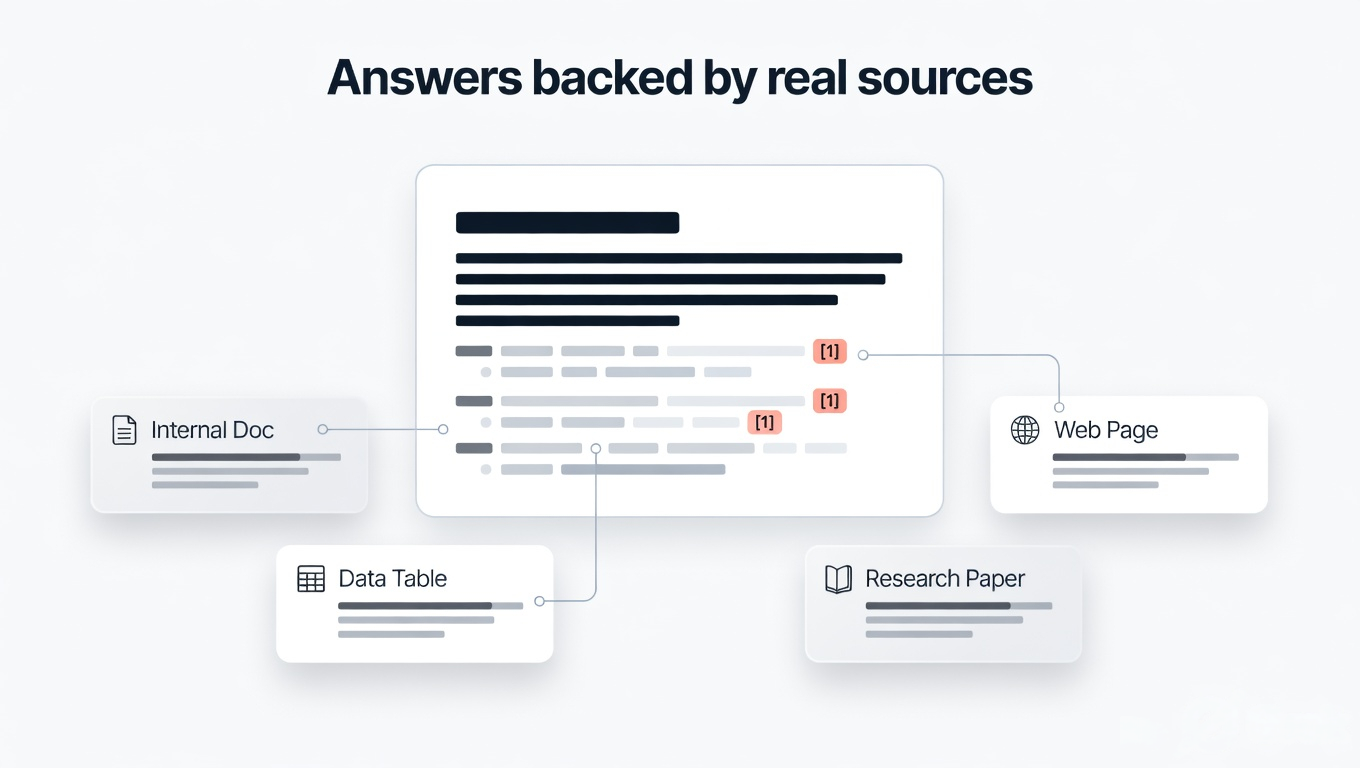
The short answer: Choose Perplexity if your priority is a mature answer engine with fast web discovery and an already available Research mode. Choose Rixx if you want cited live-web research to continue into mixed-file analysis, Python-powered data work, charts, Mermaid diagrams and exportable PDF, DOCX or Markdown deliverables in the same workspace.
Both tools can return source-backed answers and support follow-up questions. The more useful distinction is what happens after the first answer: Perplexity is centered on finding and synthesizing information, while Rixx is designed to carry that evidence into analysis and a reusable output.
There is no universal winner. The right choice depends on whether you mainly need an answer engine or a broader research-to-deliverable workflow.
Rixx vs Perplexity at a glance
| Capability | Rixx | Perplexity |
|---|---|---|
| Cited web search | Yes; live-web answers with visible queries, research steps, source panels and snippets | Yes; real-time answers with citations |
| Follow-up research | Yes | Yes |
| Deep research | Coming soon; not currently available | Available through Research mode |
| File analysis | PDFs, DOCX, text, spreadsheets, CSVs, images and links | PDFs, text, code, images, audio and video; the official file-upload guide notes that long files may be selectively extracted |
| Data analysis | Python analysis plus spreadsheet and CSV workflows | File analysis and, on eligible plans, tools for creating files and apps |
| Visual outputs | Charts, graphs and Mermaid diagrams | Image generation and file/app creation on eligible plans |
| Model choice | Multiple models | Multiple models on eligible plans; Research mode chooses models automatically |
| Deliverables | Generate or export PDF, DOCX and Markdown; share chats | Research reports can be exported or shared; additional creation features vary by plan |
| Reusable context | Memory and private Skills | Threads and project-oriented Spaces |
| Starting price | Free plan; Explorer $10/month, Pro $20/month, Max $99/month | Free and paid plans; check current Perplexity plan details |
| Best fit | Research that must become analysis, a visual or a finished document | Fast cited discovery and established deep-research workflows |
Comparison reflects publicly documented capabilities, not a hands-on benchmark. Limits and availability can vary by plan, model and file type.
Choose Rixx when the answer is only the beginning
Rixx is the better fit when your task includes several stages:
- search the current web and inspect the evidence;
- combine public sources with a PDF, spreadsheet, CSV, image or link;
- analyze numeric data with Python;
- turn findings into a chart, graph or Mermaid diagram;
- generate a PDF, DOCX or Markdown deliverable;
- preserve reusable instructions in a private Skill or continue with memory.
This makes Rixx useful for market scans, competitor briefs, policy summaries, due-diligence notes, research reports and other work where the final artifact matters as much as the initial answer. Rixx also exposes queries, steps and source panels so you can inspect how the answer was assembled rather than treating a citation list as the end of verification.
See the complete Rixx feature set or review how the Rixx workflow works.
Choose Perplexity when fast discovery is the main job
Perplexity is a strong choice when you primarily want to ask a question, scan a cited synthesis and continue exploring the web. Its established Research mode can perform multi-step research and produce a report today. Perplexity also supports broad attachment types, including audio and video transcription, which may make it a better fit when those formats are central to the task.
Perplexity may also suit people already organized around its Threads and Spaces or those who want its specific search modes and model options. If an available autonomous deep-research mode is a requirement now, Perplexity has the clear advantage: Rixx Deep Research is still coming soon.
A practical Rixx workflow
Imagine you are preparing a market-entry brief:
- Ask Rixx to find current market size estimates, regulatory changes and major competitors on the live web.
- Open the visible source snippets and verify the dates, definitions and claims that will affect the conclusion.
- Upload a customer-research DOCX and a CSV of survey results.
- Ask follow-up questions that distinguish public evidence from findings in your private files.
- Use Python analysis to calculate segment totals or trends, then create a chart and a Mermaid map of the competitive landscape.
- Generate the final brief as PDF or DOCX and share the supporting chat with a reviewer.
This is an example of how the documented features can be combined, not a claim that Rixx automatically validates every source or replaces human review.
Important limitations
- Rixx Deep Research is coming soon, so do not choose it today solely for an autonomous deep-research agent.
- Rixx MCP support is also coming soon and should not be treated as a current integration option.
- AI-generated summaries, citations, calculations and charts can contain mistakes. Open the underlying sources and verify consequential claims.
- File quality matters. Scanned pages, complex layouts and ambiguous tables may require manual checking.
- Perplexity can be a better fit for audio/video ingestion and for users who need its Research mode now.
- Feature access and usage limits can differ by plan. Review Rixx pricing and the competitor’s current plan page before deciding.
Frequently asked questions
Is Rixx a good Perplexity alternative?
Yes, if you want cited web search plus document analysis, Python, charts, diagrams and exportable files in one research workspace. If you mainly want a mature answer engine with an available deep-research mode, Perplexity may be the closer fit.
What is the main difference between Rixx and Perplexity?
Perplexity is primarily an AI answer engine for web discovery and synthesis. Rixx combines cited web search with mixed-file analysis and tools for turning research into visuals and finished documents. The overlap is real, but their workflow emphasis differs.
Does Rixx show sources?
Yes. Rixx provides citations alongside visible queries, steps, source panels and snippets so you can inspect the evidence behind an answer.
Can Rixx analyze PDFs and spreadsheets?
Yes. Rixx supports PDF, DOCX, text, spreadsheet, CSV, image and link analysis. For numeric work, it can also use Python analysis and create charts or graphs.
Does Rixx have Deep Research?
Not yet. Rixx Deep Research is coming soon. Perplexity Research mode is already available, so users who require that capability immediately should account for the difference.
Is Rixx free?
Rixx has a Free plan. Paid plans are Explorer at $10 per month, Pro at $20 per month and Max at $99 per month. Check the pricing page for current inclusions and limits.
Turn cited research into a finished deliverable
Search the live web, inspect the evidence, add your files, analyze the data and export the result without rebuilding the work in another tool.
Start with Rixx for free No claim of automatic migration or one-click transfer from Perplexity is implied.